Hiroshi Yoshida Shin-Hanga: 170+ High-Res Woodblock Prints
Hiroshi Yoshida: One Scene, Six Skies, 170+ High-Res Prints
 Edit
Edit174 high-res Hiroshi Yoshida prints, including Sailing Boats and the Japan Alps, plus process proofs. Tagged by series, JPG format, public domain in Japan.

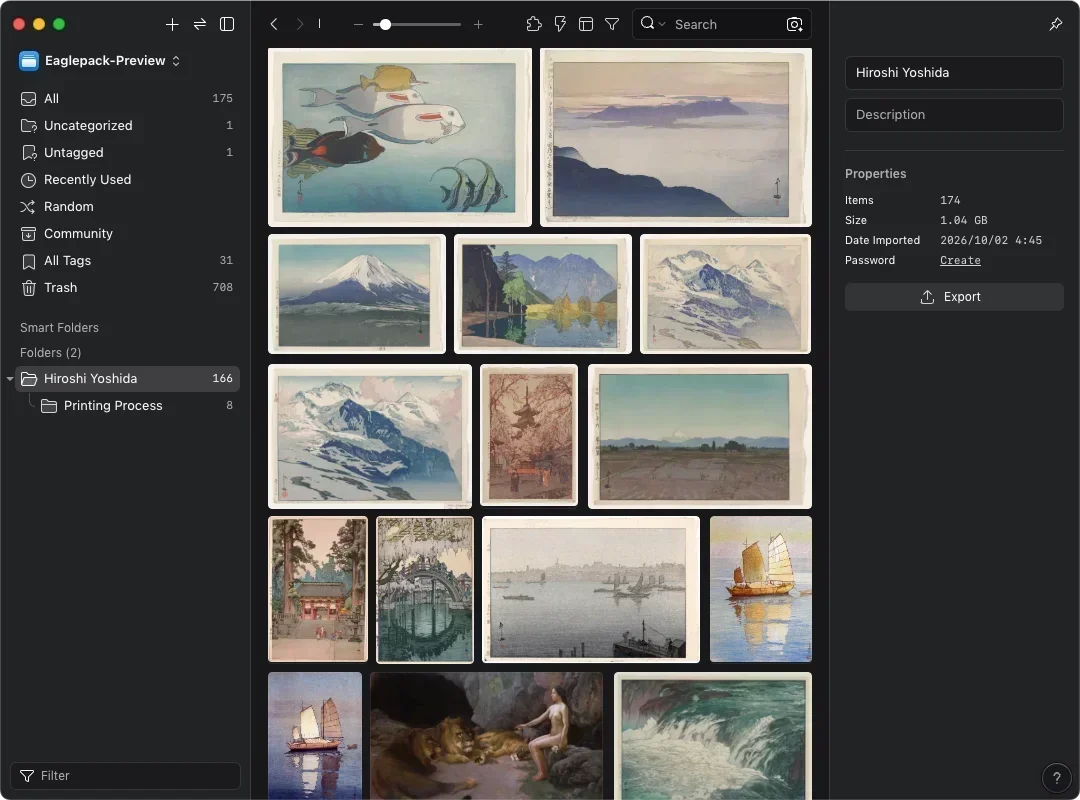
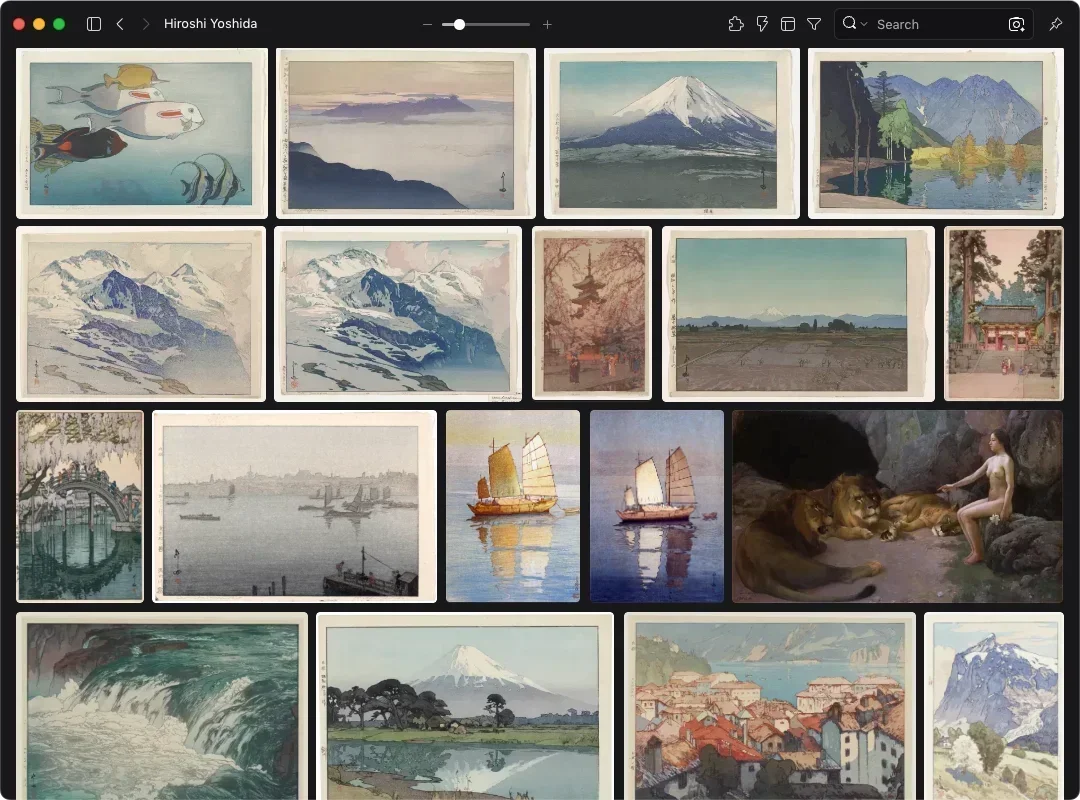
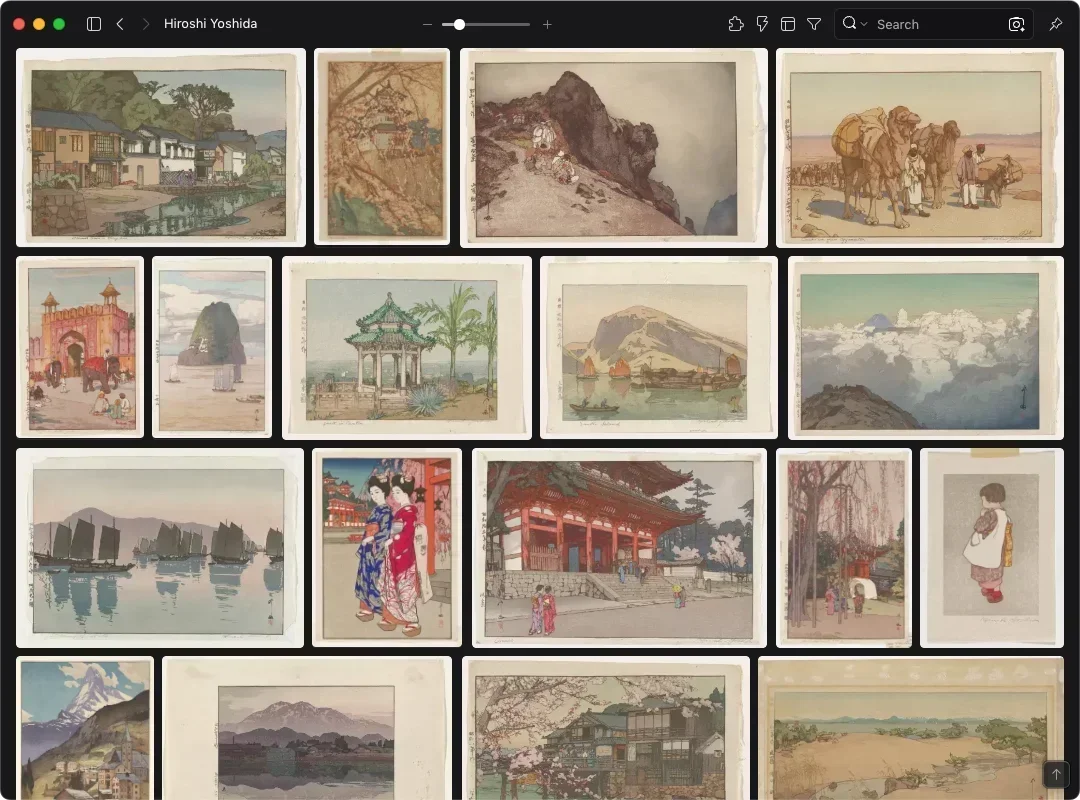
This eaglepack brings together 174 high-res images of work by Hiroshi Yoshida (1876–1950), one of the best-known artists of Japan's shin-hanga movement. His work is in the public domain in Japan, the UK, the EU, and many other countries. Most of the images come from the open-access collection of the Minneapolis Institute of Art (Mia) and span his career, from watercolors painted around 1900 to his last woodblock prints in 1946. Every image is tagged by series, such as Ten Views of Fuji and Twelve Scenes in the Japan Alps. A separate Printing Process folder shows how the colors of a single print were layered, block by block.
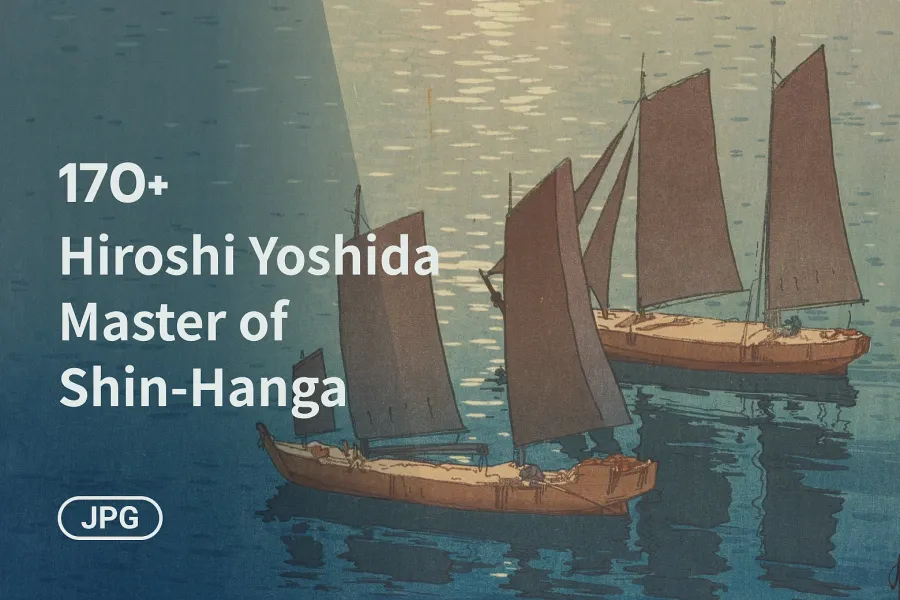
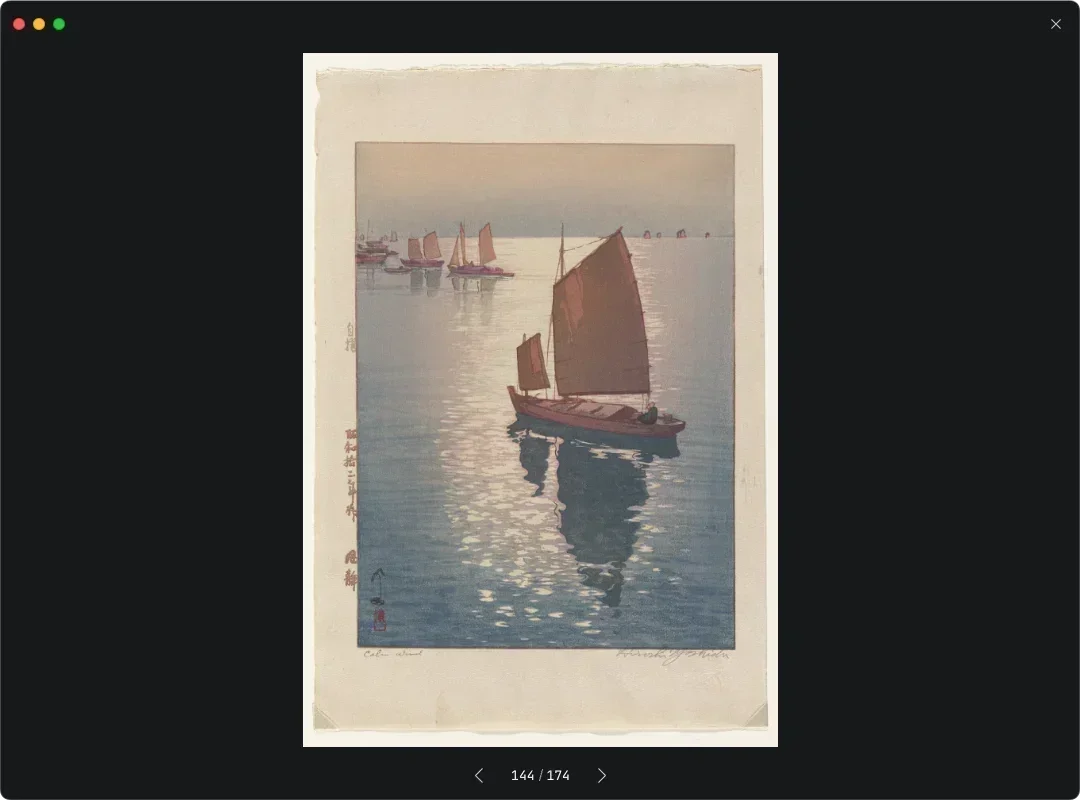
Yoshida's Sailing Boats is a good place to start. He printed the same composition from the same set of blocks six times, changing only the colors to show morning, forenoon, afternoon, mist, evening, and night. All six are in the pack. Import it into Eagle, line them up, and you have a hundred-year-old lesson in recoloring a single layout.
What Is Shin-Hanga?
Shin-hanga ("new prints") was a Japanese woodblock print movement that began around 1915. Photography and lithography had pushed traditional ukiyo-e printing into decline, so the publisher Watanabe Shōzaburō started commissioning artists to create new work using ukiyo-e methods.
The movement kept ukiyo-e's division of labor. An artist drew the design, a carver cut the blocks, a printer applied the color and pulled the prints, and a publisher handled production and sales. Landscapes, portraits of women, and birds and flowers were the main subjects. Kawase Hasui, Itō Shinsui, and Ohara Koson were among the leading artists, and the prints sold to Western collectors early on. The Toledo Museum of Art in Ohio held major shin-hanga exhibitions in 1930 and 1936.
A parallel movement, sōsaku-hanga ("creative prints"), took the opposite approach: artists designed, carved, and printed everything themselves. Shin-hanga relied on skilled specialists to refine the craft, while sōsaku-hanga put personal expression first.
Hiroshi Yoshida: From Oil Painter to His Own Publisher
Yoshida was born in 1876 in Kurume, Fukuoka, and trained as a Western-style painter in oils and watercolor. Around 1900, his watercolors won an award at the Paris Exposition.
He came to woodblock printing late. In 1920, at 44, he published his first woodblock design with Watanabe and made only eight designs for him over two years. The 1923 Great Kantō earthquake then destroyed Watanabe's workshop, along with the blocks and prints stored there.
After the earthquake, Yoshida took his surviving work on a tour of the United States and found that his woodblock prints sold well there. Back in Tokyo in 1925, he set up his own workshop at home, hired carvers and printers, and supervised every step himself. His first prints from the new studio showed the American and European scenery from that trip. In 1926 alone, he published 41 designs.
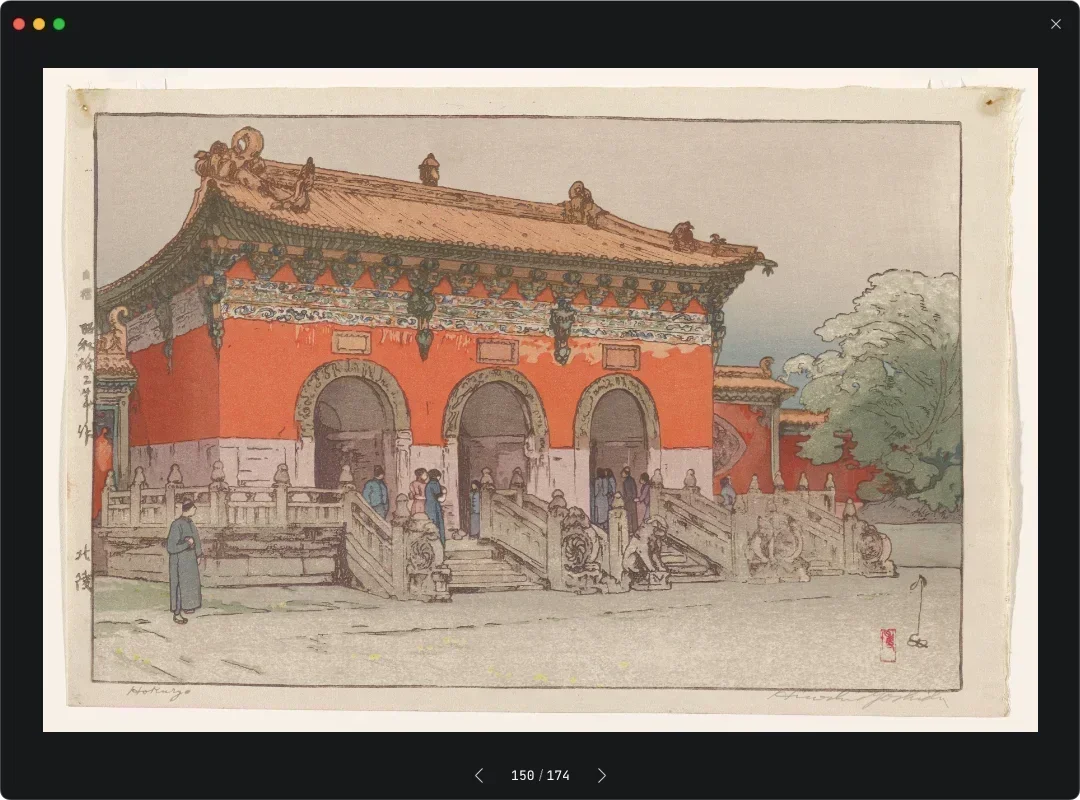
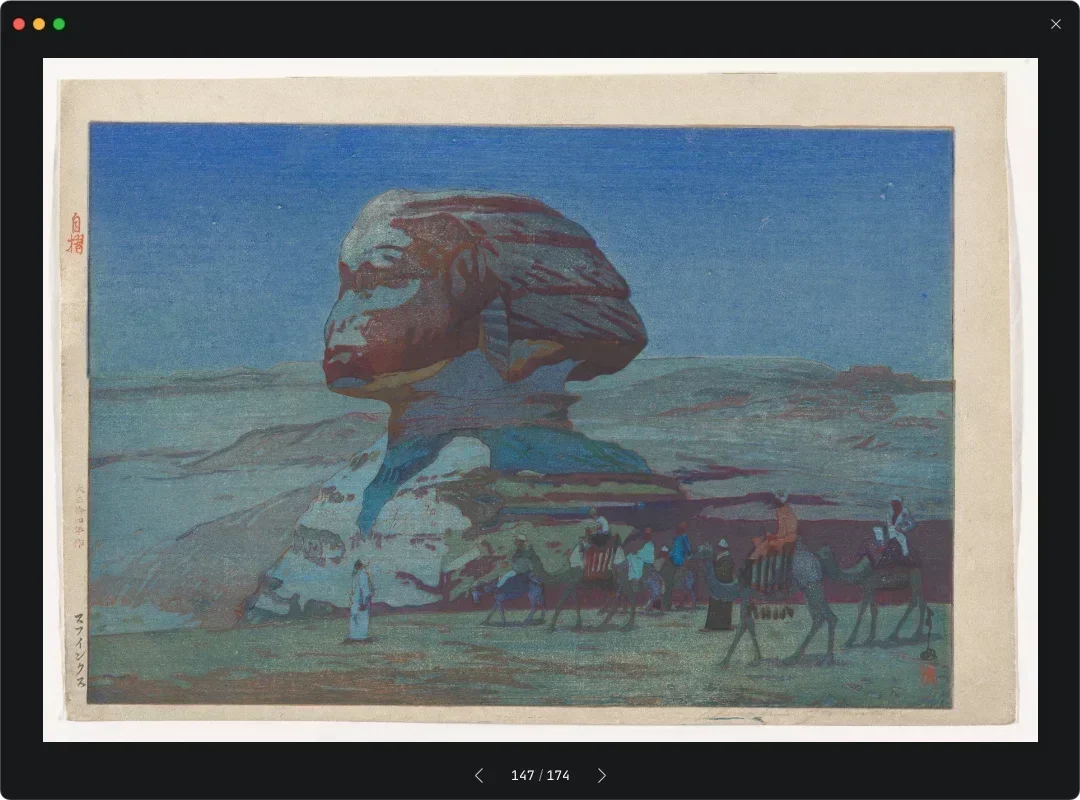
Many of his prints carry the mark jizuri (自摺) in the margin. It's often read as "printed by the artist himself," but it actually means the print was made under Yoshida's supervision and approved by him. Professional printers he employed still did the printing. Most shin-hanga artists handed their designs to a publisher; Yoshida effectively became his own.
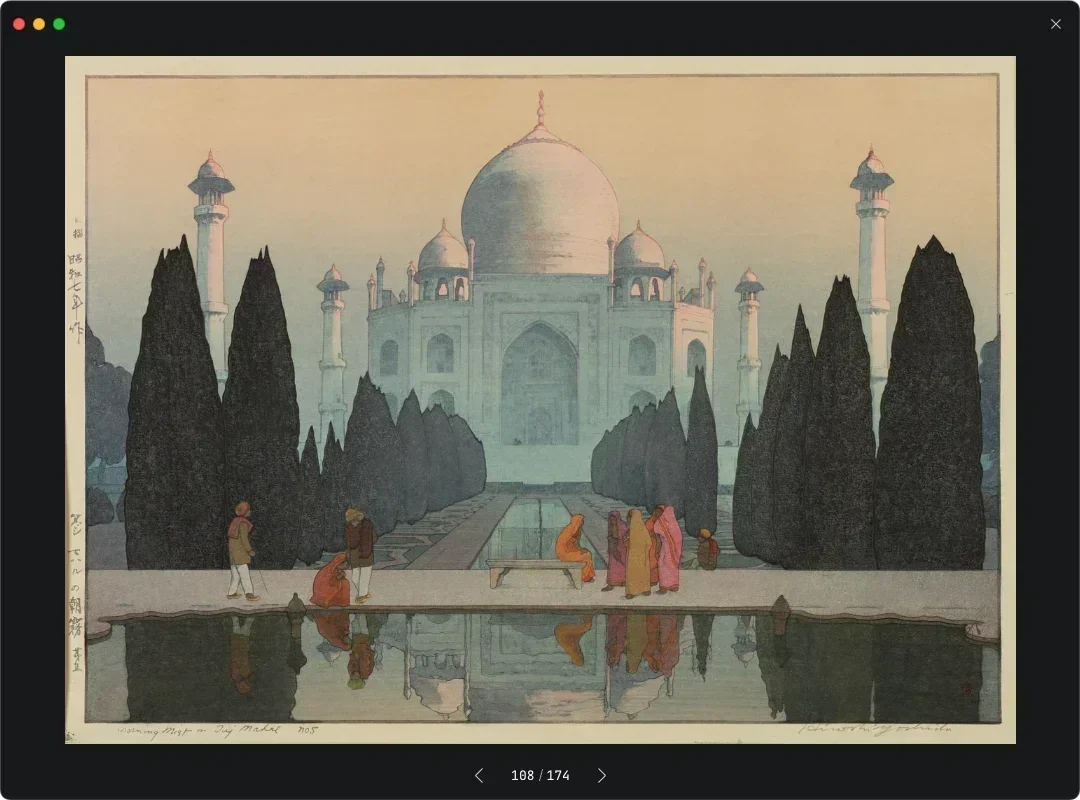
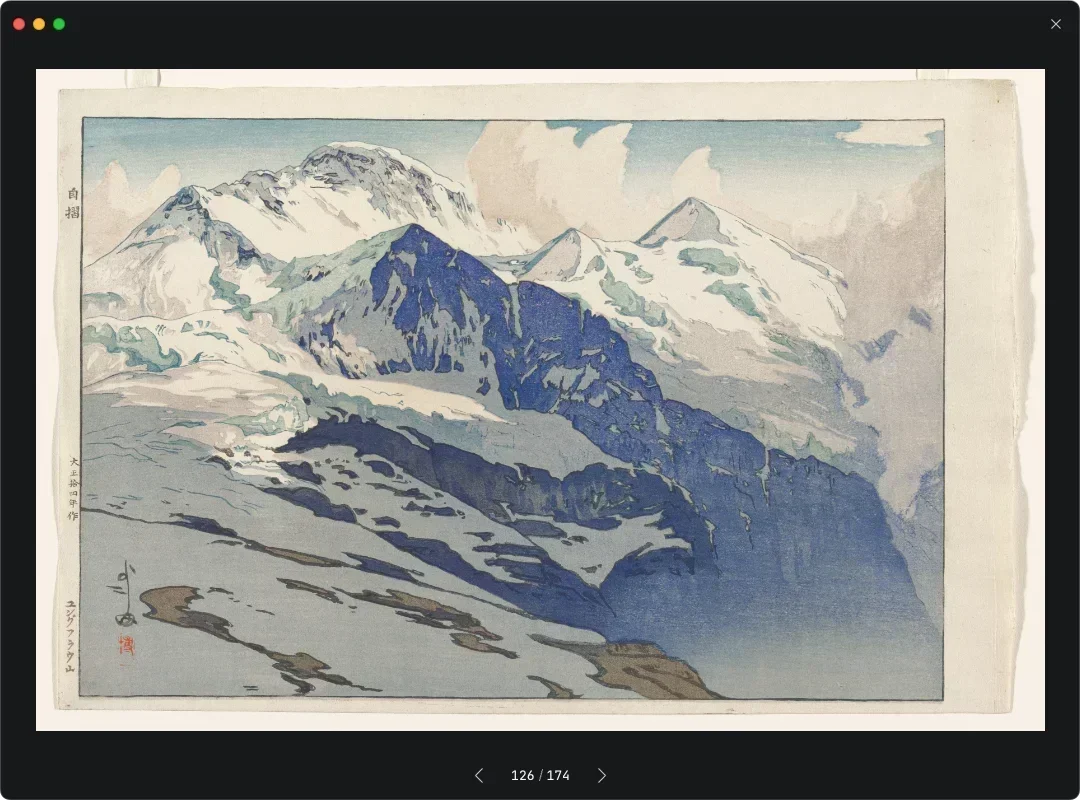
Yoshida was also a serious mountaineer who spent about half of each year sketching outdoors. The Japan Alps and Mount Fuji were subjects he returned to again and again, and he named his second son Hodaka after his favorite peak. In 1930, he traveled to India and Southeast Asia with his eldest son, Tōshi, and later published a series that includes the Taj Mahal prints. In 1939, he wrote Japanese Wood-block Printing in English, a full account of his techniques.
His work found collectors abroad early. Sigmund Freud owned one of his Mount Fuji prints, which is still at the Freud Museum in London, and the National Park Service's Grand Canyon collection holds his 1925 print The Grand Canyon. Yoshida retrospectives in Japan also like to tell a story about Princess Diana: she reportedly loved his work and bought Sarusawa Pond herself during her 1986 visit to Japan. That print is in the pack too.
What Makes Yoshida's Prints Distinctive
- Betsuzuri: the same blocks reprinted in new colors for different times of day
- Many layers of color, averaging over 30 printings per design
- Watercolor-like light, backlighting, and reflections achieved in woodblock
The six Sailing Boats prints use identical blocks. Only the color of each block changes, taking the scene from early morning through mist and sunset to night. A typical ukiyo-e print needed about 10 printings; Yoshida averaged three times that. Yomei Gate (1937) took 96 printings, the most of any print he made.
All those layers served a painter's eye. Glittering Sea shows nothing but sailboats, water, and sky, and the band of light on the backlit sea is built up one color at a time. Reflection Lake on Mount Rainier paints a whole snow-covered peak together with its mirror image in the lake.
Yoshida's Influence
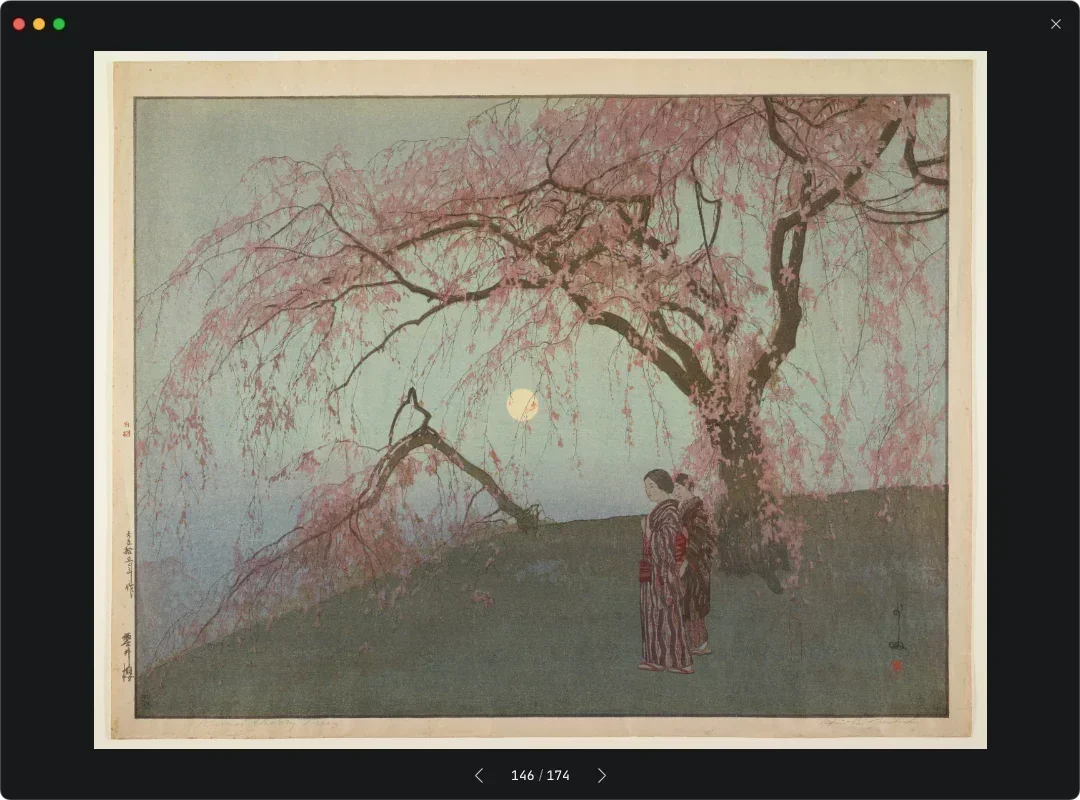
His most direct legacy is his own family. His eldest son, Tōshi Yoshida, taught printmaking at the School of the Art Institute of Chicago in 1954 and opened a printmaking school in Nagano in 1980 that took many Western students. His second son, Hodaka, and Hodaka's wife, Chizuko, moved into sōsaku-hanga and away from their father's realistic landscapes. His granddaughter Ayomi Yoshida, a contemporary artist, has made installation work based on his Kumoi Cherry Trees. In 2024, Dulwich Picture Gallery in London held an exhibition of prints by three generations of the Yoshida family.
His 1939 technique book shaped a number of later Western printmakers. David Bull, the Canadian printmaker who runs the Mokuhankan woodblock studio in Tokyo, calls himself a student of the book and recut the sailing boat from its demonstration plates in 2000. Scottish printmaker Paul Binnie created Travels with the Master, a series paying tribute to Yoshida by revisiting places he painted in the 1920s and 1930s.
Yoshida also helped bring shin-hanga to American audiences. He organized the Japanese side of the Toledo Museum of Art's 1930 exhibition, which showed 343 works by 10 artists and toured 10 American museums.
People often compare shin-hanga's rainy night streets and backlit seas with background art from Studio Ghibli or Makoto Shinkai films. The handling of light and sky gradients is very similar, but we couldn't find any record of those creators naming Yoshida as an influence, so treat it as a visual comparison. If you study animation background art, put Kagurazaka Street after a Night Rain or Glittering Sea next to a favorite anime scene and compare how each handles the sky gradient and the reflections on wet ground.
Can You Use Hiroshi Yoshida's Prints Commercially?
Yes, in most places. Yoshida died in 1950, and his work is in the public domain in Japan, the UK, the EU, and many other countries, so you can use it commercially without permission or attribution. The images in this pack come from Mia (marked Public Domain), the Cleveland Museum of Art (CC0), the Rijksmuseum, and Wikimedia Commons (public domain).
The United States is the exception to watch. Under US copyright law, works first published in 1931 or later may still be protected there, and about 67 works in this pack fall into that range. If you plan to sell products in the US, such as posters or merchandise, check each piece first.
What's in the Pack
The pack contains 174 JPG images, with a median long edge of about 7,000px, organized into two folders:
- Hiroshi Yoshida: 166 images, mostly woodblock prints, plus some watercolors and scrolls
- Printing Process: 8 images, including progressive proofs and a keyblock impression
The five progressive proofs of A Junk come from his 1939 technique book. Compare the keyblock impression for Mount Rainier with the finished print in the main folder. The watercolors, scrolls, screens, and sketches in the main folder show the Western painting background he brought to woodblock.
Every image is tagged by series, including Ten Views of Fuji, Twelve Scenes in the Japan Alps, The Inland Sea, and the India and Southeast Asia, Europe, and United States series. Click a tag in Eagle to browse by series. The notes field keeps the source collection, medium, and catalogue number for each piece.
Two groups of images carry their own tags:
- Multiple Impressions: extra copies of a print, named Impression B or C
- Low Resolution: 13 images under 1,200px, fine for browsing but not zooming
What Can You Learn from Hiroshi Yoshida's Prints?
Yoshida is worth studying for the way he used color to show time, distance, and light.
1. One Composition, Many Palettes: Sailing Boats
Line up all six Sailing Boats prints in Eagle. The linework, boat positions, and reflections are identical, and only the colors change: soft orange and pale blue in the morning, saturated teal in the afternoon, near-grayscale in the mist, pink and violet at evening, and deep blue-green with a few points of light at night.
Brand designers often need seasonal or holiday versions of the same key visual, and UI designers build light and dark modes for the same interface. Sailing Boats is ready-made color inspiration for both: keep the composition, adjust hue, value, and contrast, and the time of day and mood change completely. If you illustrate, try it as an exercise. Take one of your own pieces and recolor it to match each of the six prints.
2. Line and Color Are Separate: Progressive Proofs and the Keyblock
The keyblock impression for Mount Rainier contains only black lines. Set it beside the finished print and you can see which shapes the lines define and which ones Yoshida left entirely to color. The five progressive proofs of A Junk go further: a strip of color bars along the left edge of each sheet shows the order in which the colors were added.
In his technique book, Yoshida wrote: "Whatever is cut on the block shows; nothing can be disguised." Each block carries a single color, so he had to know exactly where that color would land before he made a cut. Risograph and screen printing work the same way, since you decide which colors get their own layer and how they overlap before anything is printed. These proofs lay that process out step by step. If you color digital illustrations in layers, they're also a good reference for building depth from just a few flat shapes.
3. Pushing Mountains Back with Color: The Japan Alps Series
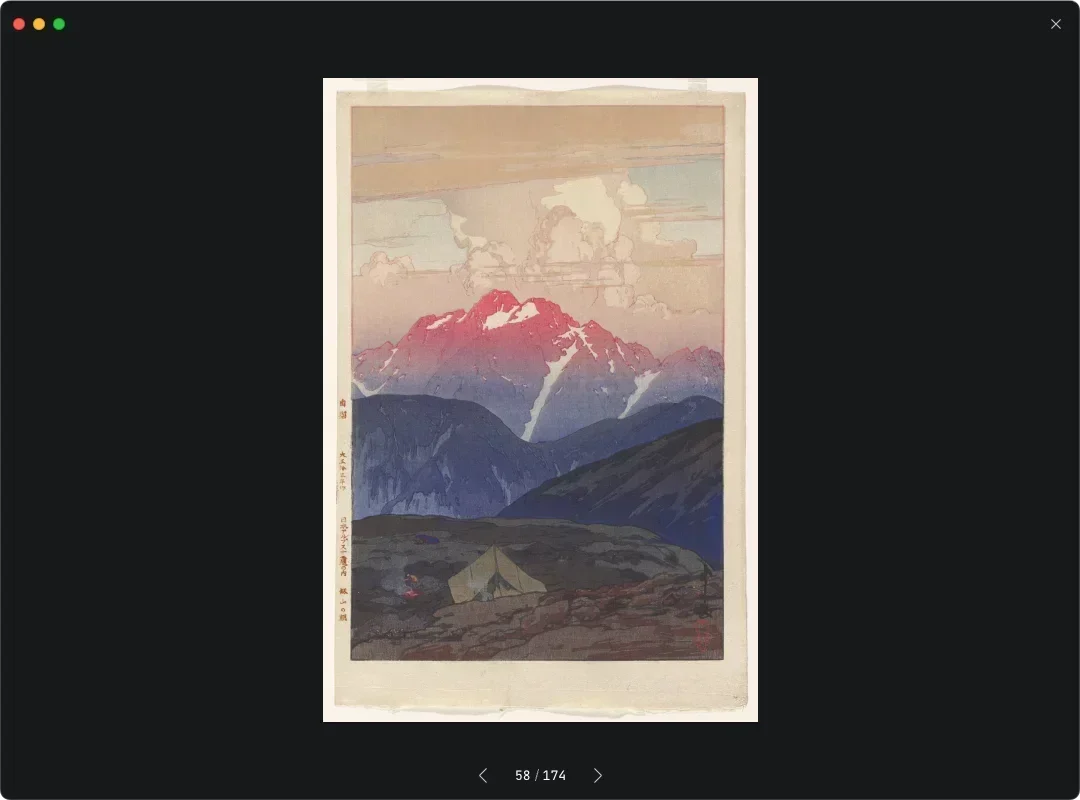
Look at Morning on Tsurugisan. The closest slope is the darkest, the middle ridges turn blue, the distant peak glows red in the dawn light, and the clouds above fade almost to the color of the paper. The farther away something is, the lower its saturation and the closer its value gets to the sky. That's atmospheric perspective.
When you paint landscape illustrations or game backgrounds, the layers of a scene can easily blur together. Almost every one of Yoshida's mountain prints shows how to separate foreground, middle ground, and background with just three or four values.
4. A Little Light in a Lot of Dark: Night Scenes and Reflections
Kagurazaka Street after a Night Rain and Night in Kyoto are both night scenes, mostly dark brown and deep blue, with small touches of warm color only in the lanterns, shopfronts, and reflections on the wet street. The light sources are small, but the surrounding darkness pulls your eye straight to them.
You can use the same setup in a dark website hero section or a poster for a night event: keep most of the area dark and put a small patch of warm color where you want the viewer to look.
5. Same Blocks, Different Colors: Comparing Impressions
The pack includes two impressions of Yoshida Village. Mount Fuji and the lake are composed the same way, but one sky leans turquoise while the other has a hint of warm color on the horizon. Every woodblock printing session meant inking the blocks again by hand, so some variation in color was always part of the process.
If you've worked on print projects, you've probably seen the same file come back in different colors after a change of paper or printer. Comparing these impressions is good practice for judging which color shifts change the mood and which fall within an acceptable range.
6. Search the Prints by Color in Eagle
When you need a palette reference like "deep blue night" or "orange-pink dusk," use Eagle's color filter to pull matching prints from these 170-plus images, then pick colors from them to build your own palette.
You may also like